
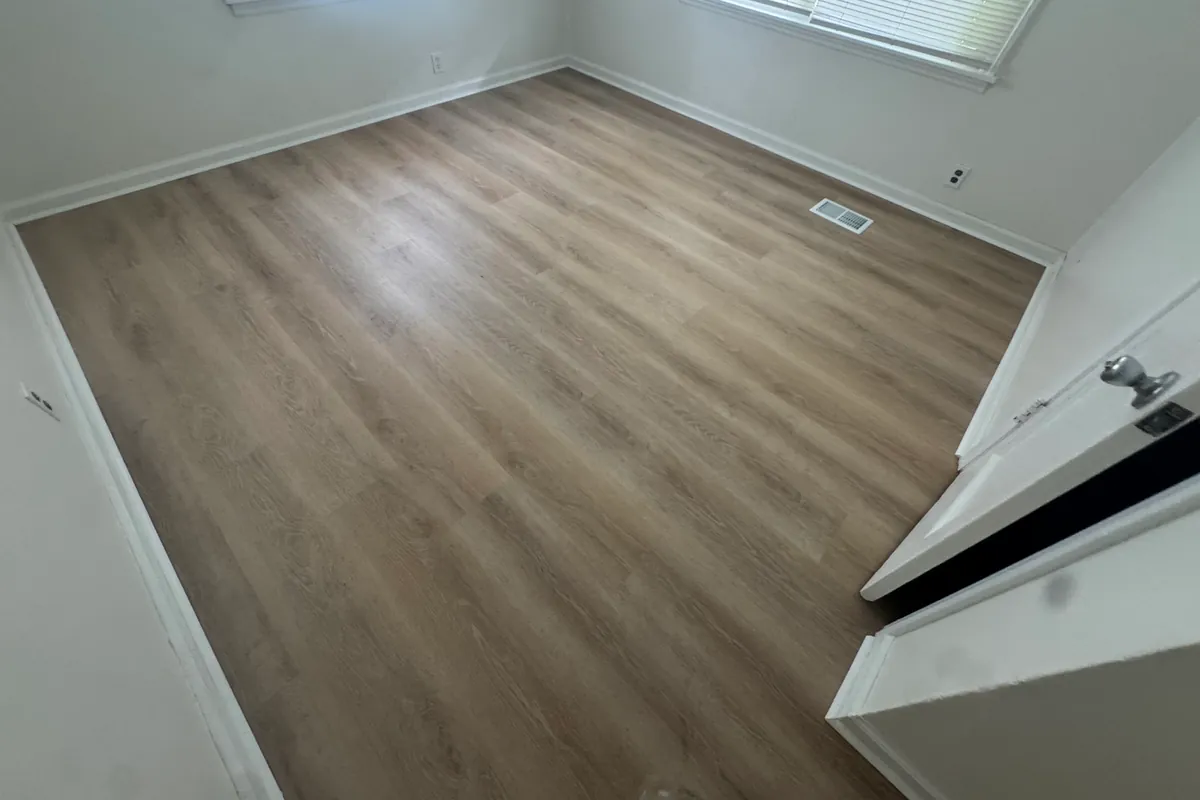
If you own rental property around Clarksville you have probably already had the argument with yourself about carpet. Here is the version of it that matters.
Carpet is a consumable
Carpet in a rental is not a durable good. It is a consumable with a replacement cycle, and around here that cycle tends to be every second tenant, sometimes every tenant.
Carpet holds odor, it holds pet damage, and once a stain sets into a traffic lane there is no cleaning it out. So it gets replaced, and it gets replaced on its schedule rather than yours.
LVP does not work that way. It is a hard surface. It cleans between tenants instead of getting replaced between tenants, and a plank that does get damaged can often be swapped individually rather than redoing the room.
The real comparison
The number people compare is the install cost, and on that single number carpet usually wins. That is the wrong number.
Compare over a five year window instead, and count:
- how many times you replace carpet in five years
- the vacancy days each replacement costs you
- what a pet deposit covers versus what pet damage actually costs
- what each surface looks like on a showing in year four
Carpet in year four looks like carpet in year four. LVP in year four looks close to LVP in year one, assuming it went down properly.
That last clause is doing a lot of work, and it is the point of the rest of this post.
The subfloor is the entire job
LVP is only as good as what it sits on. Everything that goes wrong with a floating plank floor, and this is not an exaggeration, traces back to prep.
Flatness. Manufacturers publish a tolerance, usually something like a quarter inch over ten feet. Beyond that, planks bridge across a dip and the locking edges flex every time somebody walks over it, until they separate. That is what a gapped seam a year later actually is. It is not a bad plank.
Squeaks. A subfloor that squeaks before the flooring goes down will squeak afterward, except now it is under the new floor. Screw it down first.
Soft spots. Any give underfoot means damaged sheathing. Cut it out and replace it. Covering it is throwing the flooring away.
Moisture. On slab, especially slab-on-grade or a basement, test it. LVP handles water better than most floors, but a persistently wet slab still causes problems.
Prep is genuinely most of the labor on a good LVP install. Anybody quoting a price that assumes zero subfloor work has not looked at your subfloor.
Install details that decide how it ages
Expansion gap at every wall. Vinyl moves with temperature. Butt it tight to the wall and it has nowhere to go, so it buckles in the middle of the room. The gap gets covered by baseboard or quarter round and nobody ever sees it.
Undercut the door casings. Cut the bottom of the casing and slide the plank underneath. Scribing the plank around the casing instead is faster, and it looks like a rental.
Stagger the joints properly. End joints should look random, not stair-stepped on a diagonal. A stair-step pattern is the tell of a rushed install and it is structurally weaker too.
Run the planks the long way. Usually parallel to the longest wall, or toward the main light source. It makes the room read larger.
Transitions where they belong. In the doorway, centered under the door when it is closed, so you do not see a strip from either room.
What we would still put carpet in
Bedrooms, if the tenant profile wants it and you accept the cycle. Stairs, where carpet is genuinely safer and quieter and LVP on stairs is a specialist job. And upstairs units where sound transmission to the floor below is a real complaint.
Everywhere else in a rental, hard surface wins.
What we do
Tear-out and haul-off of the old flooring, subfloor prep including leveling and squeak repair, click-lock or glue-down install, casing undercuts, transitions, quarter round and baseboard reinstall. Single rooms or whole floors.
If you have already bought the flooring from a big box store, we will install it. Just buy about ten percent extra for cuts and waste.
Call (931) 320-9818 or tell us about the unit.